
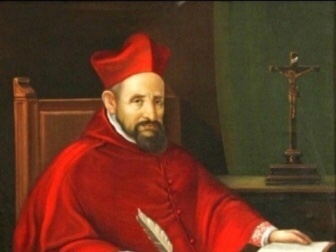
Born 4 October 1542 at Montepulciano, Tuscany, Italy ROBERTO FRANCESCO ROMOLO was the third of ten children of Vincenzo Bellarmine and Cinzia Cervini, a family of impoverished nobles. His mother, a niece of Pope Marcellus II, was dedicated to almsgiving, prayer, meditation, fasting, and mortification. Robert suffered assorted health problems all his life. Educated by Jesuits as a boy, he joined the Jesuits on 20 September 1560 over the opposition of his father who wanted Robert to enter politics. He studied at the Collegio Romano from 1560 to 1563, Jesuit centers in Florence, Italy in 1563, then in Mondovi, Piedmont, the University of Padua in 1567 and 1568, and the University of Louvain, Flanders in 1569. He was ordained a priest on Palm Sunday, 1570 in Ghent, Belgium.
He began his ministry as a professor of theology at the University of Louvain from 1570 to 1576. At the request of Pope Gregory XIII, he taught polemical theology at the Collegio Romano from 1576 to 1587. While there he wrote Disputationes de Controversiis Christianae Fidei adversus hujus temporis hereticos, the most complete work of the day to defend Catholicism against Protestant attack. He became Spiritual director of the Roman College from 1588. He taught Jesuit students and other children, writing a childrens’ catechism, Dottrina cristiana breve. He wrote a catechism for teachers, Dichiarazione piu copiosa della dottrina cristiana. He was confessor of Saint Aloysius Gonzaga until the saint’s death, then worked for the youth’s canonization. In 1590 he worked in France to defend the interests of the Church during a period of turmoil and conflict. Appointed as a member of the commission for the 1592 revision of the Vulgate Bible, he served as rector of the Collegio Romano from 1592 to 1594. He served as Jesuit provincial in Naples, Italy from 1594 to 1597. He served as theologian to Pope Clement VIII from 1597 to 1599. He was appointed examiner of bishops and consultor of the Supreme Sacred Congregation of the Roman and Universal Inquisition in 1597. He was strongly concerned with discipline among the bishops. Created Cardinal-priest on 3 March 1598 by Pope Clement VIII, he lived an austere life in Rome, giving most of his money to the poor. At one point he used the tapestries in his living quarters to clothe the poor, saying that “the walls won’t catch cold.”
He defended the Apostolic See against anti-clericals in Venice, Italy, and the political tenets of King James I of England. He wrote exhaustive works against heresies of the day. He took a fundamentally democratic position—authority originates with God, is vested in the people, who entrust it to fit rulers—a concept which brought him trouble with the kings of both England and France. He helped Saint Francis de Sales obtain formal approval of the Visitation Order. As a noted preacher, he became Archbishop of Capua, Italy in 1602. He participated in the two conclaves of 1605. He was involved in disputes between the Republic of Venice and the Vatican in 1606 and 1607 concerning clerical discipline and Vatican authority. He was also involved in the controversy between King James I and the Vatican in 1607 and 1609 concerning control of the Church in England. He authored the Tractatus de potestate Summi Pontificis in rebus temporalibus adversus Gulielmum Barclaeum, in opposition to Gallicanism. He opposed action against Galileo Galilei in 1615, and established a friendly correspondence with him, but was forced to deliver the order for the scientist to submit to the Church. Part of the conclave of 1621, he was considered for Pope. As a theological advisor to Pope Paul V, he was also head of the Vatican library, prefect of the Sacred Congregation of the Rites and prefect of the Sacred Congregation of the Index. He was proclaimed a Doctor of the Church on 17 September 1931.